IPCL or ICL: what are the differences between the two implantable lenses?
IPCL and ICL are two phakic lenses implanted between the iris and the natural lens. Same principle, same procedure, but a different material, design and range of options.
Created on
21.10.2026
·
Updated on
15.11.2026

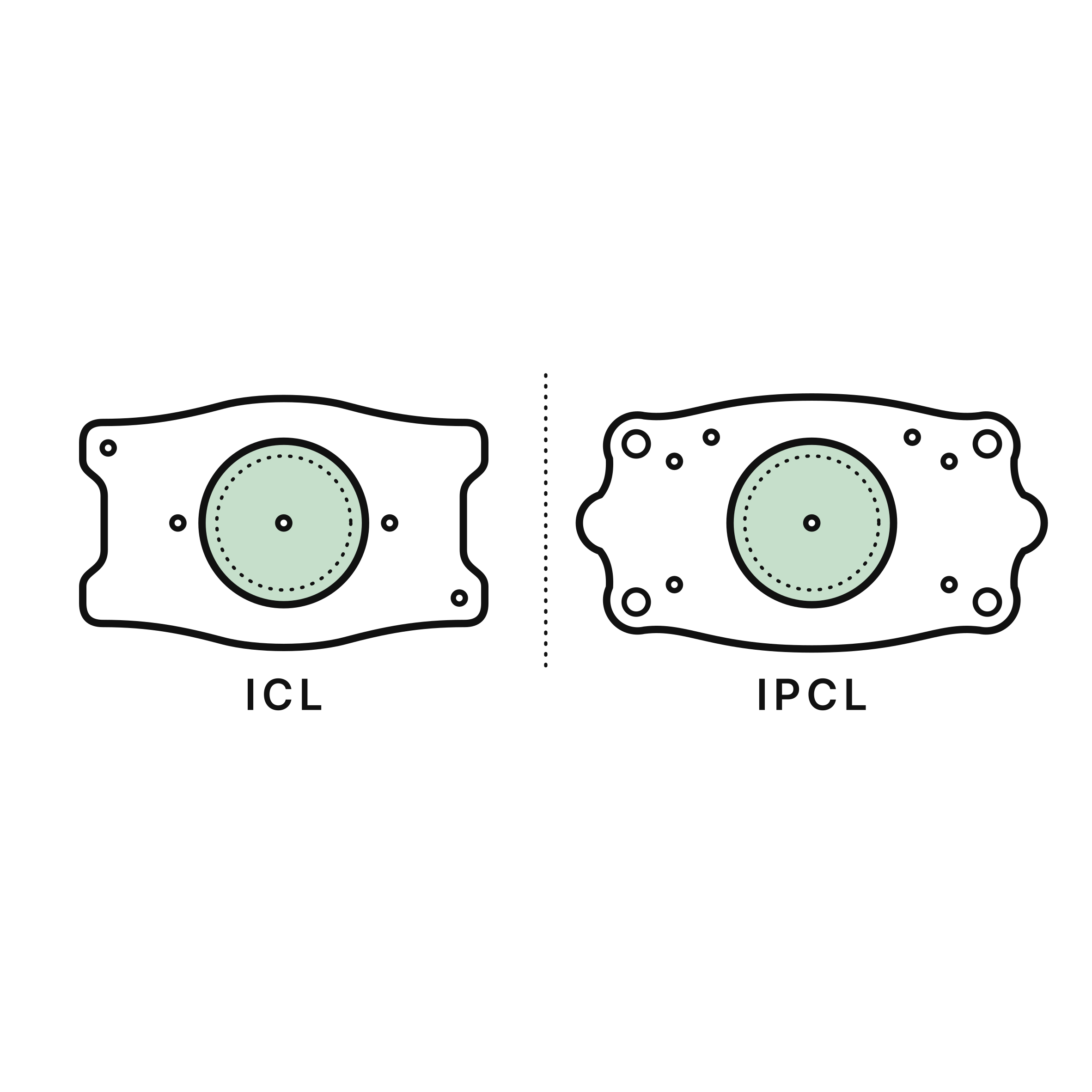
The IPCL and the ICL are two implantable phakic lenses: soft implants placed behind the iris and in front of the natural crystalline lens, to correct myopia, hyperopia and astigmatism. The principle is the same, and so is the surgical procedure. The differences lie in the material, the design of the lens, the correction options offered and the clinical track record available. This article explains what the two models involve, what really sets the two implants apart, and how the choice is made in consultation.
IPCL and ICL: two names for one principle
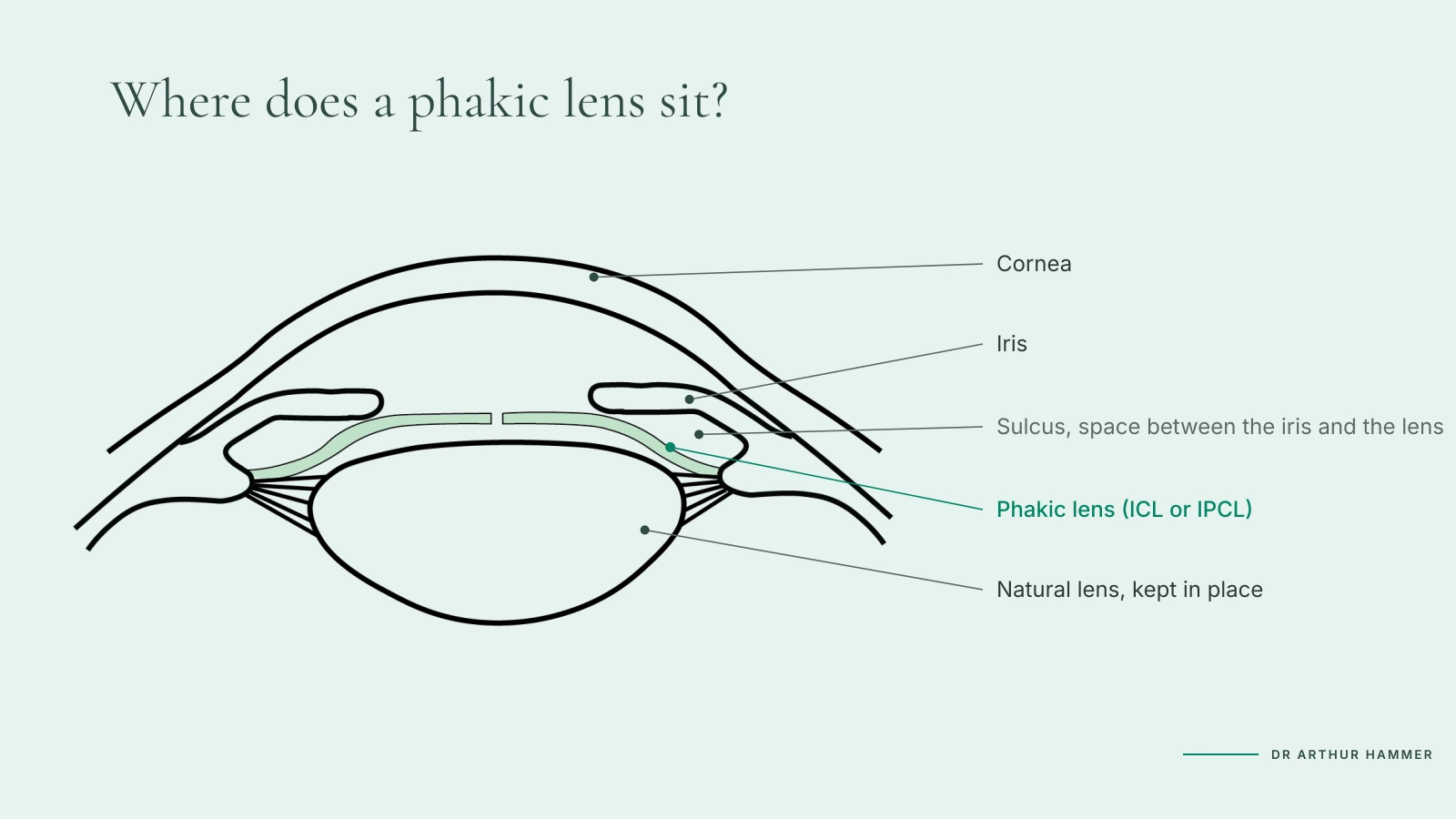
A phakic lens is an intraocular implant added to an eye that keeps its natural lens, unlike the implant placed during cataract surgery, known as a pseudophakic lens. The IPCL and the ICL both belong to this family of phakic lenses. They are positioned in the sulcus, the space between the back of the iris and the front of the crystalline lens.
It works like a pair of glasses worn inside the eye, permanently and with no maintenance. The cornea is not reshaped, no tissue is removed, and once in place the implant is invisible and cannot be felt. The general principle, the indications and the procedure are detailed on the page dedicated to implantable contact lenses (ICL/IPCL).
What the abbreviations ICL and IPCL stand for
The two abbreviations describe the same type of implant, but each emphasises a different aspect. ICL stands for Implantable Collamer Lens: the name refers to the material of the lens, Collamer. IPCL stands for Implantable Phakic Contact Lens: the name stresses the phakic nature of the implant, in other words the fact that the natural lens is kept.
In everyday language, and on many websites, the two terms are used interchangeably. In consultation, however, they refer to two implants made by two different manufacturers, each with its own characteristics. That distinction is what the rest of this article sets out.
The differences between the IPCL and the ICL
The differences between the two lenses are differences of manufacture and range, not of principle. They matter when a model is being chosen, and they have no bearing on how the operation itself is carried out.
The material
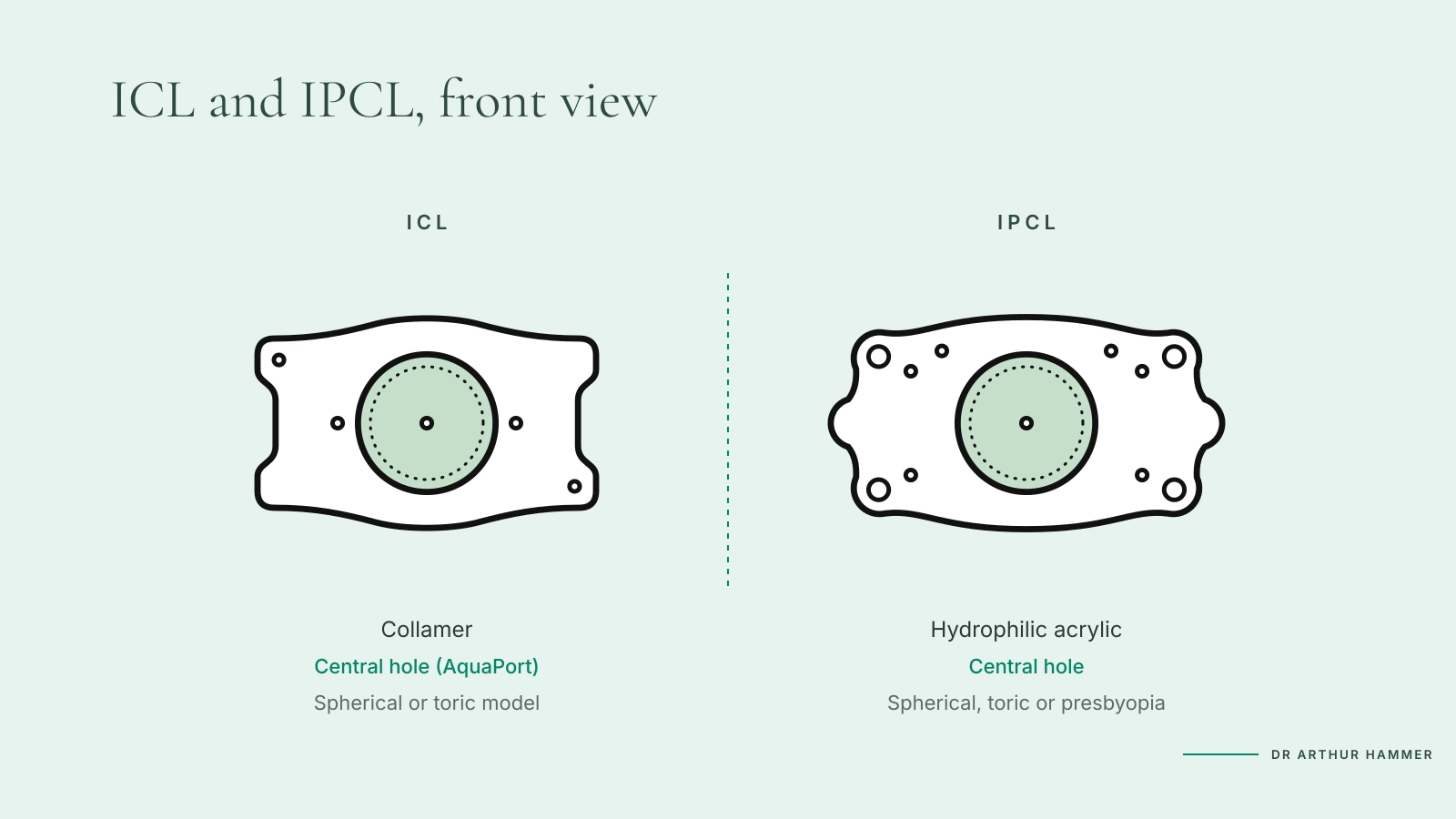
The ICL is made of Collamer, a copolymer that combines collagen with a soft polymer. This material is known for its biocompatibility, meaning how well it is tolerated by the tissues of the eye, and for its stability over time. The IPCL is made of hydrophilic acrylic, a soft material also used for other intraocular implants. Both materials are foldable, which allows the lens to be inserted through a small incision.
The design and the central hole
The current generations of both lenses feature a central hole. On the ICL it is called the AquaPort, described on the procedure page. This small opening lets the aqueous humour, the fluid that fills the front of the eye, circulate freely and reduces the risk of a rise in intraocular pressure. It also removes the need for an iridotomy, a small laser opening in the iris, before the operation. The recent generation of the IPCL adopts the same principle of a central opening, with its own design.
Note that for the ICL, only the models correcting myopia (with or without astigmatism) feature an AquaPort. Models correcting hyperopia cannot accommodate this central hole, because most of the optical correction is located at the centre of the lens. For the IPCL, hyperopic models correcting up to +3.50 D feature a central hole. Beyond this correction it is no longer present, for the same reasons as for hyperopic ICLs.
The correction options
This is the most tangible difference for a patient. Both implants exist in a spherical version, for myopia and hyperopia, and in a toric version, which also corrects astigmatism. The IPCL manufacturer also offers multifocal models designed for presbyopia, which aim to correct distance and near vision with the same implant. Their indications and correction ranges differ from one model to another. Presbyopia can also be treated at the level of the cornea, for example with Presby-LASIK.
The correction ranges and the sizes available also vary from one manufacturer to the other. This is checked during the assessment, from the measurements of your eye, not from a catalogue.
The clinical track record
The ICL is the phakic lens with the longest history and the largest body of scientific literature, including follow-up studies over many years. The IPCL is more recent on the European market and its data have built up more recently. This track record is one of the factors the surgeon weighs, especially for a young patient who will keep the implant for several decades.
This table summarises the main points. The exact characteristics depend on the model and generation of the implant chosen for your eye.
What does not change: indications, assessment and procedure
A phakic lens, whatever its name, is intended for patients whose refractive error is not best treated by laser vision correction: high myopia, hyperopia or astigmatism, a thin or irregular cornea, marked dry eye, or simply the wish for a reversible option that leaves the cornea untouched. The comparison between the two approaches is developed in the article ICL or LASIK for high myopia.
The pre-operative assessment is the same for both implants. It includes subjective and cycloplegic refraction, the length of the eye, the dimensions of the anterior chamber (depth and diameter) and of the cornea (thickness, shape and diameter), the density of the corneal endothelial cells and an examination of the back of the eye. These measurements confirm eligibility, rule out a contraindication such as glaucoma or early cataract, and determine the power and size of the implant.
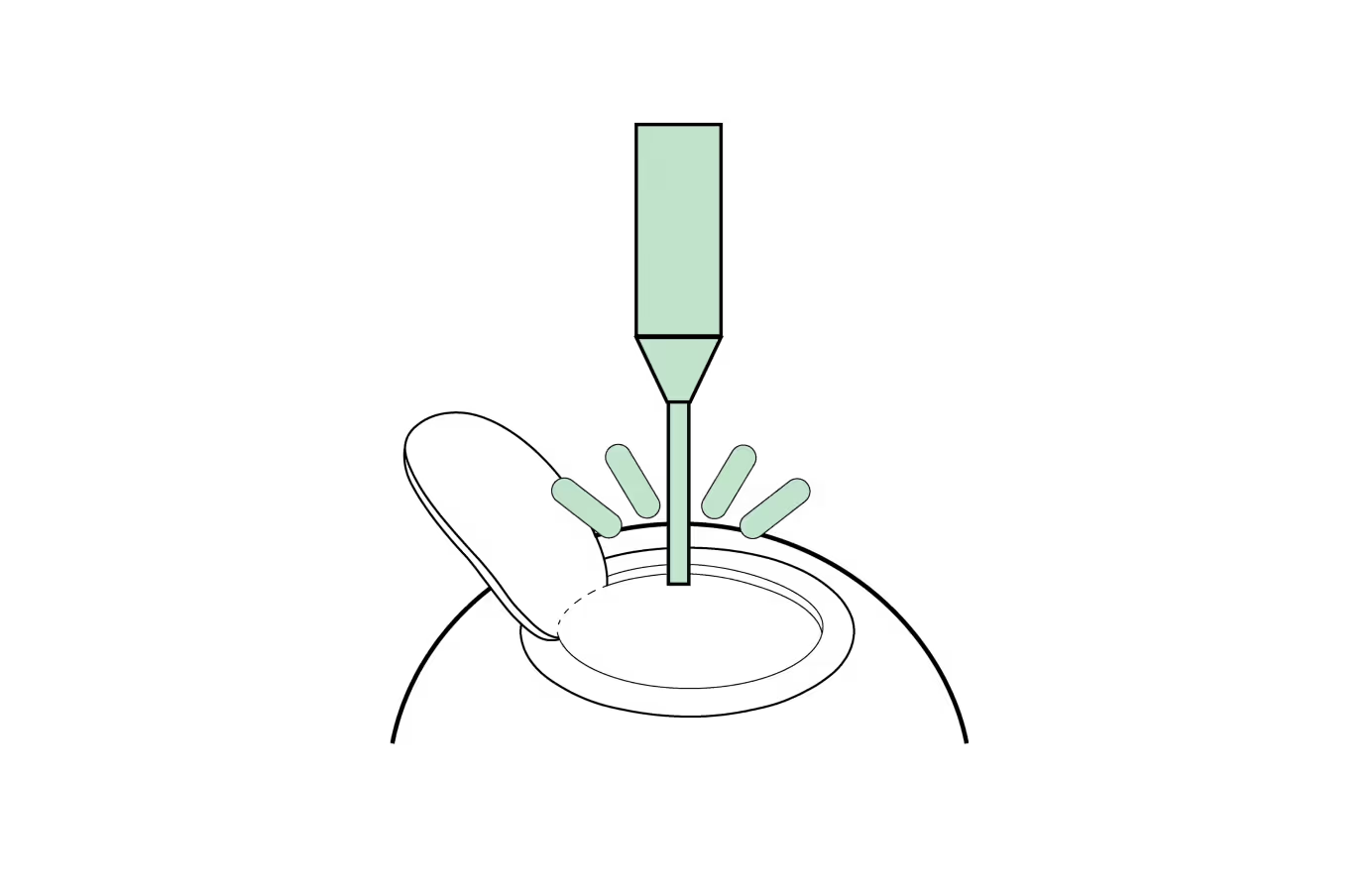
The operation is identical: performed as a day case under anaesthetic drops, it usually takes 10 to 15 minutes per eye, and both eyes are most often treated on the same day. The lens is rolled up on itself, inserted through a small incision, then unfolded and positioned behind the iris. Most patients notice clear vision within hours. The aftermath is described stage by stage in the article on recovery after ICL surgery.
How is the choice between IPCL and ICL made?
The choice between the two lenses is a surgeon's decision, made from the assessment and discussed with the patient. Several factors come into play:
- the correction required, and the models that cover it with the exact power needed
- the size available for your eye, because an implant that is too large or too small is the leading cause of complications
- whether or not there is astigmatism to correct with a toric model
- any presbyopia, which can be treated in different ways
- the clinical track record of the model
- the surgeon's experience with each platform, which determines the accuracy of the sizing calculation
The last point deserves a word of explanation. Sizing a phakic lens relies on formulas specific to each implant and on the experience the surgeon has built up with it. A surgeon who has mastered one platform obtains more predictable results with it. This is why the question is not so much "which is the best lens" as "which is the best lens for this eye, in the hands of this surgeon".
Risks and follow-up, common to both implants
The risks of phakic lenses are rare but real, and they are the same for the IPCL and the ICL. The first is a transient rise in intraocular pressure in the first few days, which drops normalise and which the central hole helps prevent. Night halos and glare can occur in the first weeks and usually fade with time.
An early cataract, meaning a clouding of the natural lens favoured by contact with the implant, is rare. An implant size chosen precisely, from the pre-operative measurements, markedly reduces its likelihood. Infection and inflammation are exceptional and are monitored at the check-ups. In every case, the implant can be removed or exchanged if the situation requires it.
Follow-up is identical for both lenses: a check the next day, then at 1 week, 1 month and 3 months, followed by regular annual ophthalmic follow-up over the long term. This allows the intraocular pressure, the position of the implant and the health of the corneal endothelium to be monitored. These risks and this follow-up are explained in consultation before any decision.
Cost and reimbursement in Switzerland
Phakic lens implantation, whether IPCL or ICL, is considered elective surgery. As a rule it is therefore not reimbursed by basic insurance (LAMal). Some supplementary insurance plans contribute to the cost under certain conditions: it is worth checking with your insurer before the procedure.
The cost varies with the lens model, the correction of astigmatism and the care setting. A personalised quote is provided after the consultation. For a first estimate, the price calculator on this site compares the cost of refractive surgery with that of glasses and contact lenses over time.
In practice at Dr Hammer's clinic
Dr Arthur Hammer is an FMH ophthalmic surgeon, MD-PhD, FEBO, FEBOS-CR and CertLRS. He consults in Lausanne (Swiss Visio Montchoisi and Swiss Visio Beau-Rivage), in Neuchâtel (Swiss Visio La Providence) and in Geneva. He performs ICL/IPCL surgery at the Clinique de Montchoisi in Lausanne. Refractive surgery with phakic implants is one of his fields of practice: he shared his experience of the EVO ICL at the ESCRS 2025 congress and takes part in advanced surgical workshops dedicated to this implant.
Every phakic implant project begins with a full assessment. It is at the end of this assessment that the lens model is discussed, according to your correction, the anatomy of your eye and your expectations, in particular regarding near vision.
The consultation arrangements in French-speaking Switzerland are set out on the page implantable ICL lenses in Switzerland, and the complete guide to the implant is available in the article implantable ICL lenses: the guide to correcting high myopia. Dr Hammer's background is detailed on this site.
When to seek advice
A specialist consultation is indicated if you wear a strong prescription and wish to reduce your dependence on glasses or contact lenses, if laser surgery has been advised against because of a thin or irregular cornea, or if your contact lenses have become difficult to tolerate. Only a full examination can determine whether a phakic implant is an option, and which one.
FAQ: common questions about the IPCL and the ICL
What does IPCL stand for?
IPCL is the abbreviation of Implantable Phakic Contact Lens. The word phakic means that the natural crystalline lens stays in place: the implant is added in front of it, behind the iris, without removing any tissue. The IPCL corrects myopia, hyperopia and astigmatism in patients for whom laser surgery is not the best option. Diffractive multifocal models can also treat presbyopia by correcting distance and near vision with the same implant.
What does ICL stand for?
ICL stands for Implantable Collamer Lens. Collamer is the material of this implant, a copolymer that combines collagen with a soft polymer. The ICL sits in the same space as the IPCL, between the iris and the natural lens. It is the phakic lens with the longest clinical track record in the ophthalmology literature, as it has been available for longer.
Do the IPCL and the ICL correct the same refractive errors?
Broadly, yes. Both lenses correct myopia, hyperopia and astigmatism, the latter through toric models. The IPCL also exists in diffractive multifocal models designed for presbyopia, with indications specific to each model. The exact correction ranges depend on the model and the sizes available: the pre-operative assessment confirms whether your prescription is covered.
Which is safer, IPCL or ICL?
Both implants rely on the same principle and carry the same rare risks: a transient rise in intraocular pressure, temporary night halos, early cataract, and exceptionally infection. Safety depends above all on the precision of the pre-operative measurements and on the choice of implant size, far more than on the name of the lens. The ICL has the longer clinical track record; data on the IPCL have grown more recently.
Can I choose between IPCL and ICL myself?
The choice is made with the surgeon, on the basis of the assessment. It takes into account the correction needed, the depth of the anterior chamber, the endothelial cell count, any presbyopia and the sizes available for your eye. Your preferences matter, for instance the wish to correct near vision, but technical feasibility comes before preference.
Is the operation different depending on the lens?
No. In both cases the procedure is performed as a day case, under anaesthetic drops, and usually takes 10 to 15 minutes per eye. The lens, which is very soft, is rolled up on itself, inserted through a small incision, then unfolded and positioned behind the iris. Aftercare, eye drops and check-ups are identical. The recovery is described step by step in the article on recovery after an ICL.
Are IPCL and ICL lenses reimbursed in Switzerland?
Refractive surgery, including phakic implants, is considered an elective procedure. As a rule it is therefore not covered by basic insurance (LAMal), whatever the lens model. Some supplementary insurance plans contribute to the cost under certain conditions. A personalised quote is provided after the consultation, and the calculator on this site gives a first estimate.
Can an IPCL or ICL lens be removed or replaced?
Yes, and this is common to both lenses. The implant does not alter the cornea and removes no tissue: it can be removed or exchanged by the surgeon if needed, for example during cataract surgery later in life. This reversibility sets phakic lenses apart from laser techniques, which permanently reshape the cornea.
In summary
The IPCL and the ICL are two phakic lenses with an identical principle: a soft implant placed between the iris and the natural lens, which corrects the refractive error without touching the cornea and remains reversible. They differ in their material, their design, their correction options and their clinical track record, which is longer for the ICL.
The choice between the two is not made on the name, but on the measurements of your eye, the correction required and the surgeon's experience with each implant. For an assessment or a second opinion, you can book an appointment with Dr Arthur Hammer, an FMH ophthalmologist specialising in refractive and corneal surgery in Lausanne and Geneva.


Related articles
Discover our other articles that might interest you


Book a consultation
Swiss Visio Montchoisi
1006 Lausanne, Switzerland