Penetrating keratoplasty: understanding the full-thickness corneal transplant
Everything about penetrating keratoplasty (PKP): when this full corneal transplant remains the best option, how it is performed and what recovery involves.
Created on
03.08.2026
·
Updated on
08.08.2026

A penetrating keratoplasty, or PKP, is a corneal transplant that replaces the full thickness of the cornea with a donor graft. It remains indicated when the cornea is affected through all of its layers, for example after trauma, a severe infection or the failure of a previous graft. Long the reference technique, it has given ground to lamellar transplants (DALK, DMEK, DSAEK), which are more targeted. This article explains when penetrating keratoplasty still fully matters, how it is performed, what its risks are and how it is covered in Switzerland. A specialist examination is always required to assess each situation.
What is penetrating keratoplasty (PKP)?
Penetrating keratoplasty is a surgery that replaces the entire thickness of a diseased cornea with a graft of healthy cornea. The word "penetrating" means the procedure crosses all layers, from the epithelium at the surface to the endothelium, the innermost layer of the cornea.
The cornea is the transparent window at the front of the eye. It provides much of the eye's focusing power. When it loses its transparency or its regularity across its whole thickness, a full transplant can become the best option.
It is also called a full-thickness corneal transplant, or in short, PK or PKP. The graft comes from a tissue bank and is prepared according to strict quality and safety criteria.
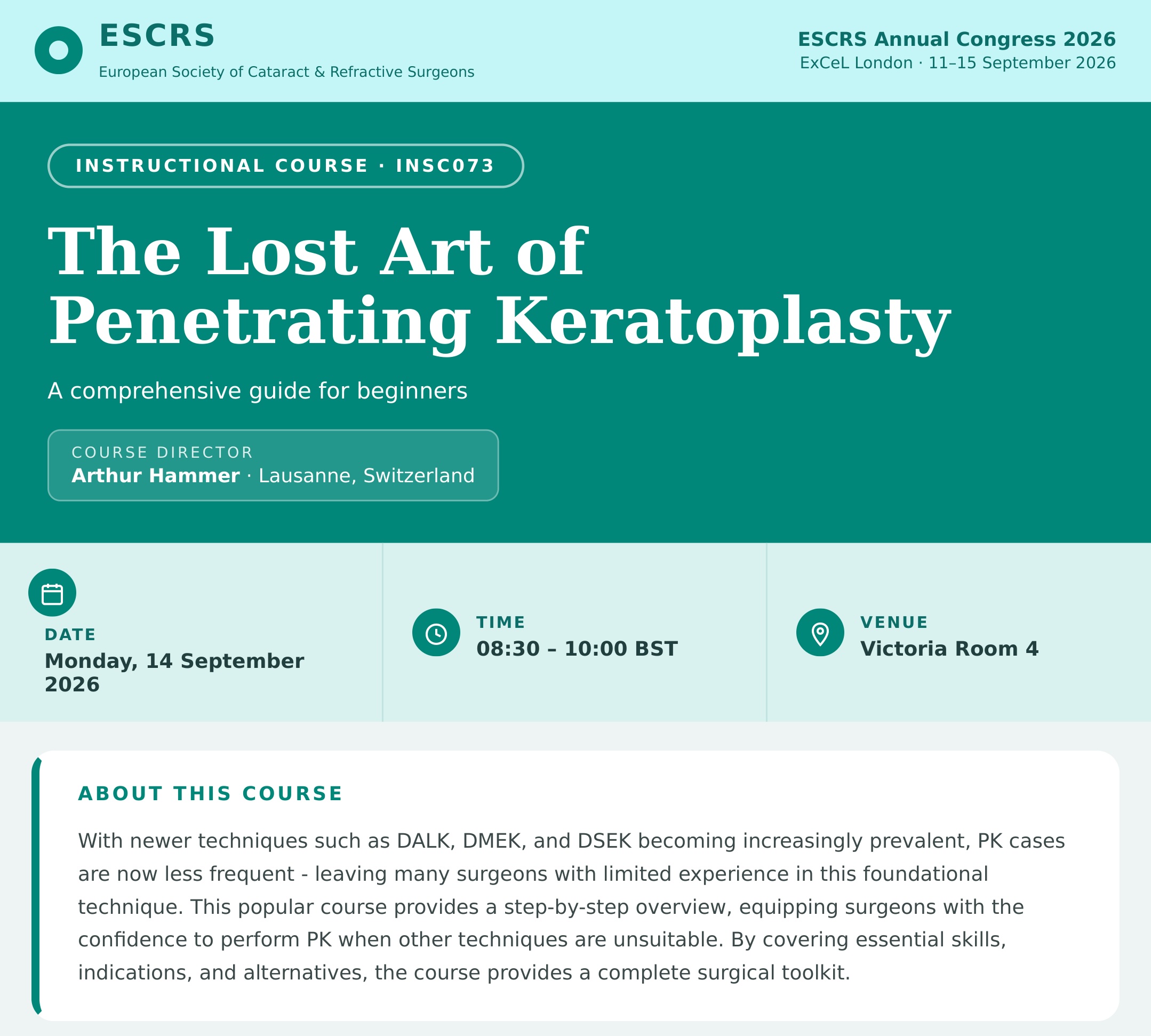
This technique differs from lamellar transplants, which replace only part of the corneal layers. Dr Arthur Hammer, an FMH ophthalmic surgeon specialised in cornea, chairs the ESCRS 2026 instructional course dedicated to PKP, in London.
When is penetrating keratoplasty indicated?
Penetrating keratoplasty is indicated when the cornea is affected through its full thickness and no partial transplant is sufficient. It addresses conditions involving the superficial layers, the central stroma and the deep endothelium at the same time.
The main indications include:
- deep corneal scars, after trauma or a severe corneal infection;
- keratoconus at a very advanced stage, when the cornea is too distorted or too thin for a lamellar transplant;
- certain corneal dystrophies involving several layers;
- the failure of a previous graft, lamellar or penetrating, when it cannot be resolved with a lamellar graft.
- perforations or major thinning of the cornea.
Today, many situations once treated with PKP fall to more targeted techniques. Keratoconus, for example, often benefits from crosslinking, intracorneal ring segments or an anterior lamellar transplant (DALK) before a full transplant is considered. You will find more detail on our dedicated keratoconus surgery page.
Only a specialist examination, including corneal topography/tomography and imaging (corneal OCT), can determine whether penetrating keratoplasty is truly the best option for a given patient.
PKP or lamellar transplant (DALK, DMEK, DSAEK): what are the differences?
A lamellar transplant is a keratoplasty that replaces only a selected part of the corneal layers, unlike PKP, which replaces them all. The choice between these techniques depends on which layer is affected.
When only the inner layer (the endothelium) is diseased, as in Fuchs dystrophy or corneal oedema, a thin endothelial graft such as DMEK or DSAEK is often sufficient. When only the anterior layers are affected, a DALK transplant can preserve the patient's own endothelium.
These lamellar approaches generally offer faster recovery and a lower rejection risk, because they keep part of the original cornea. This is why the share of penetrating transplants has fallen markedly in recent years in favour of lamellar techniques. Penetrating keratoplasty nonetheless remains irreplaceable when all layers are affected.
For an overview of the techniques, see our page on corneal transplants (keratoplasties).
How is penetrating keratoplasty performed?
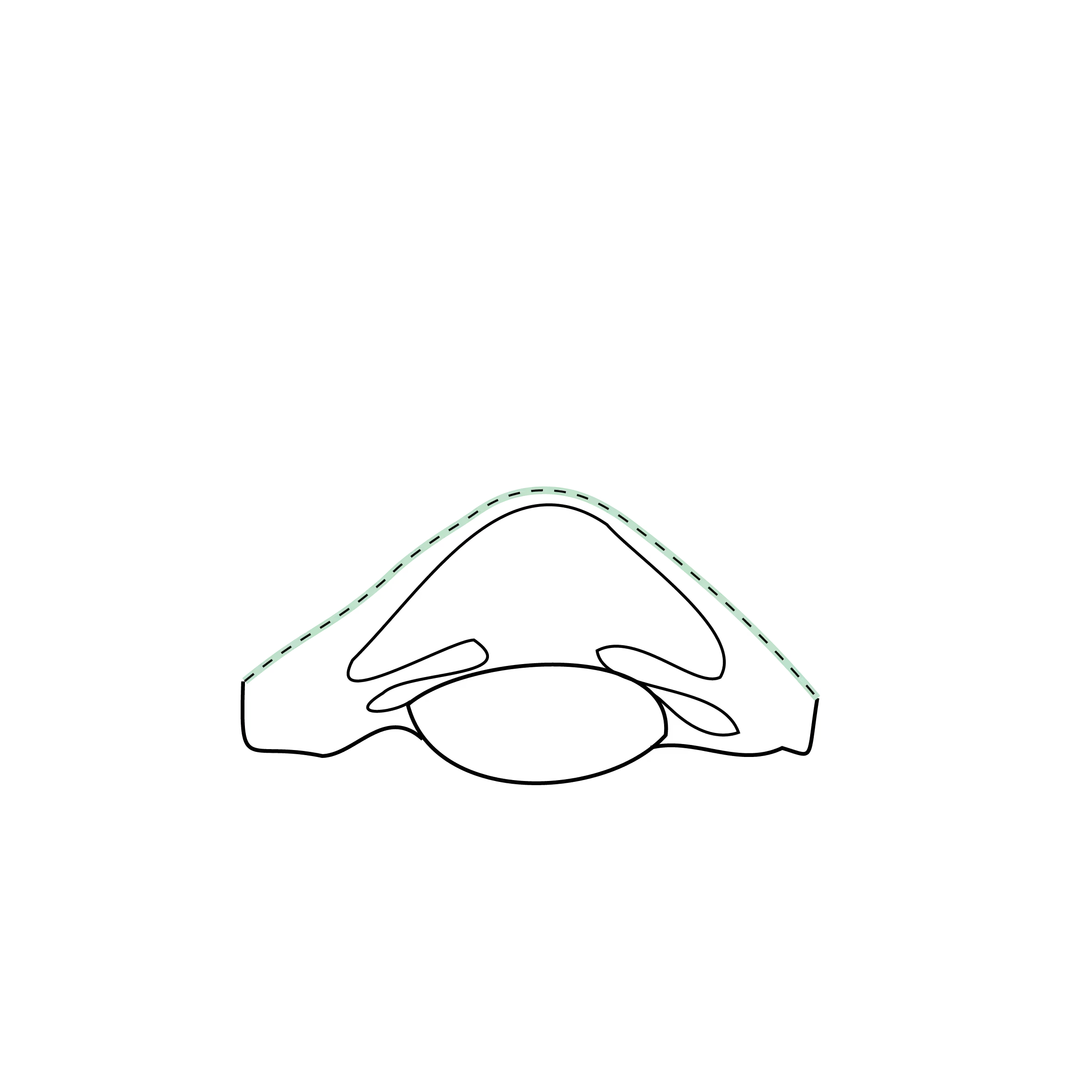
Penetrating keratoplasty is a microsurgical procedure that involves cutting out the diseased cornea and then suturing a donor graft of a similar and appropriate size in its place. It is performed in the operating theatre, under a microscope.
Before the procedure
A complete preoperative assessment always precedes the surgery. It includes precise corneal measurement by topography/tomography and corneal OCT, an examination of the whole eye and a general check-up. The graft is provided by a tissue bank and verified before use.
The procedure is most often performed on an inpatient basis. It usually takes place under general anaesthesia but depending on the situation can also be done under local anesthesia. This choice is discussed with the patient during the preoperative consultation and the anesthesist team analyses the patient's file and can request a pre-anesthetic consultation if needed.
During the procedure
The main steps of a full-thickness corneal transplant are as follows:
The procedure generally lasts between 45 and 60 minutes. In some cases it is combined with cataract surgery and the placement of an intraocular artificial lens implant, which is called a triple procedure.
In practice with Dr Hammer:
Dr Arthur Hammer, an FMH ophthalmic surgeon (MD-PhD, FEBO, FEBOS-CR), performs corneal surgery in French-speaking Switzerland, notably at Clinique de Montchoisi in Lausanne. His practice covers the full range of keratoplasties, from thin endothelial grafts to penetrating keratoplasty. Each indication is set after a complete corneal assessment, always favouring the least invasive technique suited to the condition.
Recovery after a full-thickness corneal transplant
Recovery after penetrating keratoplasty is gradual and extends over several months. Unlike lamellar transplants, healing of a full transplant is slow, because the sutures must hold the graft for a long time.
In the first weeks, treatment with eye drops, in particular topical corticosteroids, is prescribed to limit inflammation and the risk of rejection. This treatment often continues over a long period, with a gradual taper.
The sutures are removed gradually, sometimes over twelve to eighteen months, depending on healing and astigmatism. Vision stabilises slowly, and optical correction with glasses, rigid contact lenses or an additional procedure is frequently needed.
Significant astigmatism is one of the main limitations of this technique. It may require adjustments after surgery. This point is explained to the patient from the consultation onward, so the procedure is approached with realistic expectations.
One instruction remains essential: do not rub the operated eye and follow the monitoring schedule closely. Regular check-ups allow any complication to be detected early.
What are the risks and complications of penetrating keratoplasty?
Like any surgery, penetrating keratoplasty carries risks that the surgeon explains before the procedure. Knowing them helps to prevent them and to react quickly if needed.
The main possible complications are:
- graft rejection, an immune reaction against the transplanted cornea. The risk of rejection is higher than with lamellar transplants;
- graft failure, which can occur later and sometimes leads to a new transplant;
- high astigmatism, common after this type of transplant;
- raised eye pressure or glaucoma, favoured by corticosteroids;
- infection or a suture-related problem.
Rejection remains the most feared complication, but it can often be controlled if managed early. This is why regular follow-up and prompt recognition of warning signs are decisive. These topics are among those covered in the ESCRS 2026 course dedicated to PKP.
When should you seek urgent care after a corneal transplant?
Graft rejection is an ophthalmic emergency that can, if treated quickly, be reversible in a proportion of cases. Recognising its signs is essential for any transplant patient.
You should seek care without delay in case of:
- an unusual drop in vision in the operated eye;
- marked redness of the eye;
- new or increasing pain;
- unusual sensitivity to light (photophobia).
These symptoms may point to rejection or another complication, but only a specialist examination can make the diagnosis. When in doubt, it is always better to contact your ophthalmologist quickly rather than wait.
How much does a corneal transplant cost in Switzerland and what does LAMal cover?
In Switzerland, a corneal transplant is recognised as a medically necessary procedure. As such, for patient covered by Swiss medical insurances, it is in principle covered by basic insurance (LAMal) when the indication is set by a specialist.
The patient still bears the usual cost-sharing, namely the chosen annual deductible (franchise) and the 10% co-payment (quote-part), within legal limits. The exact amount depends on the insurance contract and the individual situation.
For patient not covered by Swiss medical insurances, cost can vary depending on the inpatient or outpatient care, duration of hospital stay, complexity of the surgery, cost of the donor material, etc. A detailed quote is provided prior to surgery.
For any question about coverage, it is advisable to check the terms with your insurer as international insurances might cover such costs.
FAQ: frequently asked questions about penetrating keratoplasty
What is the difference between penetrating keratoplasty and a lamellar transplant?
Penetrating keratoplasty replaces the entire thickness of the cornea, whereas a lamellar transplant replaces only part of it. The lamellar techniques (DALK, DMEK, DSAEK) are preferred when only certain layers are diseased, because then often offer faster recovery and a lower rejection risk. The penetrating transplant remains indicated when the cornea is affected through its full thickness. The choice is made after a complete corneal assessment by a specialist.
Is a corneal transplant painful?
The procedure itself is not painful, as it is performed under local or general anaesthesia. In the following days, discomfort, a foreign-body sensation or watering are possible. New or increasing pain after surgery should never be ignored: it warrants a prompt check-up. Postoperative treatment and follow-up are designed to ensure the best possible comfort during healing.
How long does recovery take after a PKP?
Recovery from penetrating keratoplasty is slow and extends over several months, sometimes more than a year. The sutures are removed gradually, often over twelve to eighteen months, and vision stabilises step by step. Correction with glasses or rigid contact lenses is frequently needed afterwards. This timeframe, longer than with a lamellar transplant, is explained to the patient before the procedure so expectations are realistic.
Can rejection occur several years after the transplant?
Yes, graft rejection can occur long after the procedure, even after several years. This is why regular ophthalmic follow-up remains important throughout the life of the graft. Prompt recognition of warning signs, such as a drop in vision, redness or pain, often allows effective management. When in doubt, you should seek care without waiting.
Is penetrating keratoplasty covered by LAMal?
A corneal transplant for patient covered by a Swiss medical insurance is in principle covered by basic insurance (LAMal) when it is medically indicated by a specialist. The patient keeps the usual cost-sharing: the annual deductible (franchise) and the 10% co-payment (quote-part). The precise terms depend on the insurance contract. It is advisable to check your coverage with your insurer and to discuss these aspects during the preoperative consultation.
Can you drive or work after a corneal transplant?
Returning to activities depends on how healing and visual recovery progress, which vary from one patient to another. Driving is only possible once vision allows it and after the surgeon's agreement. Likewise, returning to work depends on the occupation and postoperative instructions. These elements are adapted case by case during follow-up visits.
Does keratoconus always require a penetrating transplant?
No. Most keratoconus cases do not require a penetrating transplant. Crosslinking, intracorneal ring segments, customized PRK combined with crosslinking or an anterior lamellar transplant (DALK) are often considered before a full transplant. Penetrating keratoplasty is reserved for very advanced forms, with a cornea that is too distorted, too thin or scarred. Only a specialist examination can define the strategy suited to each patient.
Where can you have a corneal transplant in French-speaking Switzerland?
Corneal surgery is performed by specialised surgeons, in suitable facilities in French-speaking Switzerland. Dr Arthur Hammer, an FMH ophthalmologist specialised in cornea, practises notably in Lausanne, within the Swiss Visio / Swiss Medical Network. A prior consultation allows the indication to be assessed, the most suitable technique to be explained and all questions to be answered before planning the procedure.
In conclusion
Penetrating keratoplasty remains a fundamental technique of corneal surgery, even in the era of lamellar transplants. It is still the best option when the cornea is affected through its full thickness, provided there is a rigorous assessment and attentive follow-up. Its results rely as much on the precision of the procedure as on the early recognition of complications.
If you have a corneal condition or if a transplant has been mentioned to you, a specialist consultation allows your situation to be reviewed. To learn more about Dr Hammer's background and expertise, visit the about page or book an appointment at the clinic.





Related articles
Discover our other articles that might interest you
Book a consultation
Swiss Visio Montchoisi
1006 Lausanne, Switzerland